
My first personal encounter with something resembling War was back in April 1986 when the USA attacked Colonel Gaddafi – one of my very first postings described the episode.
That event was, of course, not really War as currently understood – more a one-off action of ruthless retaliation aimed at catching the Libyan leader’s personal attention to get him to stop promoting terrorism against US targets.
In the big scheme of things it worked well, culminating years later in Gaddafi renouncing weapons of mass destruction after some brilliant UK/US private diplomacy. One of the unambiguous high-spots of the Bush/Blair policy era.
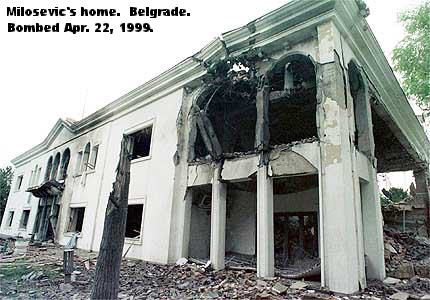
Another warlike event was the NATO bombing of Serbia in 1999 aimed at stopping Milosevic from oppressing Kosovo Albanians. This was a far wider action, killing several thousand Serbs. It was not an open military aim to kill Milosevic personally (as far as I know) although his villa in Dedinje did take a missile through the front door keyhole.
When does violent military activity move from being a limited action aimed at individual targets to a generalised ‘war’ in which two sides try to destroy each other ‘anonymously’ as it were?
I did not like the NATO bombing of Serbia, reasonable as its aims were. There seemed to be a lot of lawyers poring over NATO targeting policy, wittering that attacks aimed at killing Milosevic and other leaders personally amounted to unacceptable assassination/murder outside international law norms. But if international law leads us to kill and maim thousands of hapless Serbian conscripts and not a far smaller number of senior people directly responsible for the whole mess, international law is a ass.
My guess is that here as in many other areas, our policies and norms were drawn up many years ago to deal with quite different problems which were managed in the way they were in part because of the then available technology. The technology has moved on, yet the policies and procedures remain and have grown in luxuriance and complexity, their original raison d’etre long forgotten.
Which is all a long-winded way of urging everyone to read this long but remarkable piece of work about the future of war – and the role of robots in it.
Think about all the wars of the nineteenth century and then WW1 and WW2. Vast armies locked in sprawling mechanised slaughter, primarily because the people who started the conflicts could mobilise these forces for mass carnage and hope to prevail and stay alive.
Now look at the Israeli action in Gaza, such as taking out specific members of the Iran Unit. And maybe the curious absence of urgency in the collective Arab response to it. Arab leaders know exactly what Israel is doing in cutting Hamas down to size man by man, and quietly think that this just fine by them?
In short, War is becoming Very Personal. It is possible to use robot weapons to find and hit individuals who start and drive forward conflict, largely avoiding other unintended civilian casualties on the scale seen over the preevious thousand years.
Will ‘war’ increasingly merge with the techniques used by states to combat gangsterism – where a small bunch of people grab weapons and hope to compel a wider public to support them?
I expect that it will – and that we urgently need new legal principles to manage this utterly different situation.
Share this page:


